Friederike Hübner and Ulrich Tränkle
Summary
This short article presents characteristic aspects of the ecology and growth habit of Aloe asperifolia, with particular emphasis on the climatic conditions at its natural habitats. Photographs illustrate the habitat and the specific microsites occupied by the species. Some notes on greenhouse cultivation are also provided.
Introduction
During several work-related trips to Namibia we were able to observe Aloe asperifolia – a species only rarely encountered in cultivation – in its natural habitat. Aloe asperifolia has a wide distribution, from Walvis Bay in the south to the southern Kaokoveld. The species was particularly frequent around Swakopmund, in the outer central Namib, an extremely barren landscape characterised by extensive pale gravel lichen fields and black dolerite ridges.
The plant
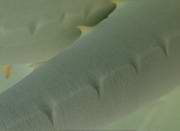
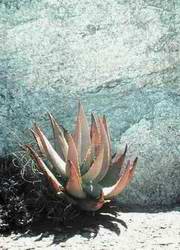
Aloe asperifolia has fresh grey-green leaves that are very broad at the base, bordered by a yellowish margin with strong yellow spines that later turn brown. The name “asperifolia” aptly describes the rough, sandpaper-like leaf surface (see Fig. 1). Young plants appear stemless, while older specimens develop the typical short, creeping stem. Its oldest part is abraded by sand and water until almost leafless and typically becomes an almost charred black-brown. Most stems we observed were up to 50 cm long; only a few exceeded 1 m. The Afrikaans names refer to this characteristic growth habit: “kraalaalwyn”, recalling the often circular layout of traditional kraals, and “heksekringe”, analogous to fairy rings formed by mushrooms. Large rings of Aloe are preserved especially in the sandy gravel of the plains, such as in the area where Welwitschia mirabilis occurs. Younger and very vigorous plants, however, grow among the black rock blocks of the ridges (Figs. 2 and 3), where water availability is considerably better throughout the year. Alongside lichens growing on the rocks, these sites also support Lavrania marlothii, Hoodia pedicellata, Hoodia currorii, Pelargonium klinghardense and, of course, Sarcocaulon species, especially Sarcocaulon marlothii and Sarcocaulon salmoniflora.
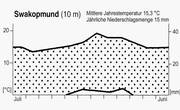
The inflorescence of Aloe asperifolia is angled sideways to almost prostrate and very loosely set with small, approximately 3 cm long, reddish to pink-red flowers. Flowering is mainly in March and April, although it may shift in years with unusual rainfall. Court (1991) describes the flowers as rather unspectacular – but that judgement changes when no other flowering plant, however small, can be found within 200 m. In conventional climatic terms, based on weather-station measurements, this part of the Namib is extremely dry, as the climate diagram in Fig. 4 appears to demonstrate. Only once to three times per century does enough rain fall for the desert to become completely green. Mean annual precipitation is about 15 mm and mean annual temperature 15.3 °C: an extremely arid climate. Standard meteorological instruments, however, do not measure the water supplied by atmospheric humidity and fog to favourable microsites. The coastal town of Swakopmund experiences around 200 foggy days – or, more accurately, foggy nights – each year.
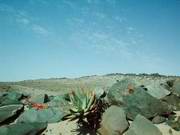
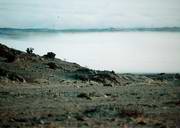
It is not only the relatively high coastal fog banks, carried inland from the cold Benguela Current, that can make the daytime climate seem almost cool. At night conditions can become distinctly uncomfortable. Anyone with the opportunity should spend several nights between August and October about 20–30 km inland from the coast. With some luck one may experience fog so dense that finding the tent becomes difficult (remnants of such fog are shown in Fig. 5). The droplets are clearly visible in torchlight and condense particularly on the black rocky ridges, which cool very rapidly at night. During the day, shading by the rocks reduces heating and thus the drying of the soil surface. Plants at these sites therefore receive an almost regular water supply that would never be inferred from the climate diagram alone. Walter made similar observations in the 1930s and again in the 1970s.
Cultivation
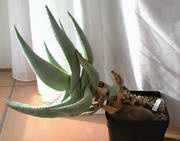
In cultivation, Aloe asperifolia likewise requires fairly regular watering and fertilising. Even small young plants soon lean to one side and cannot be persuaded to abandon their creeping habit with stones or stakes. Our plants are grown all year in the greenhouse in a sandy cactus substrate containing about 20% humus. They do not require the sunniest position, but insufficient light quickly results in weak coloration and elongated growth. The 12-year-old seedlings grow rather slowly. The species is best suited to a ground bed, where the typical stem creeping along the soil surface can develop. Unfortunately Aloe asperifolia tends to grow particularly strongly during winter. In sunny years this is not a problem, but several weeks of dull, overcast weather make the lack of light clearly visible in the plants. We have not yet installed artificial lighting. The structured, pale grey-green surface of the very thick, large leaves, contrasted with the yellow marginal teeth, makes the species especially attractive to enthusiasts. Our plants have not yet flowered (see Fig. 6).
References
Walter, H.; Breckle, S. (1984): Ökologie der Erde. Vol. 2: Spezielle Ökologie der Tropischen und Subtropischen Zonen. 461 pp. (Very detailed, with many explanatory illustrations.)
Walter, H.; Breckle, S. (1999): Vegetation und Klimazonen. 7th edition. 544 pp. (A concise overview of climate and site conditions in the vegetation zones of the world.)
Craven, P.; Marais, C. (1986): Namib Flora – von Swakopmund zur großen Welwitschia über Goanikontes. 126 pp. (An attractive small book with many drawings; following the described route is worthwhile because it passes through many different Namib habitats; not a specialist textbook.)
Court, D. (1981; revised edition 2001): Succulent Flora of Southern Africa. 224 pp. (A useful overview of southern African succulents, with many photographs but only brief descriptions; some genera are omitted entirely from the revised edition.)