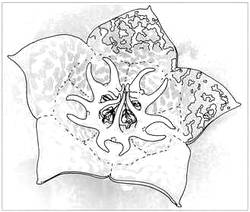
After the last circular, I received an email from a member who said that although he had read the articles with interest and was an enthusiastic seed grower, he could not for the life of him match the terms used in the text to the structures of the flower. He was right. Without illustrations, the floral structure of asclepiads is difficult to understand, so I would like to provide them here.
First, the most important terms: different authors use different terminology for floral structures.
Table 1 gives an overview of commonly used synonyms and makes no claim to completeness.
| Albers & Meve (German) | Anglo-American terminology | Commonly used terms |
|---|---|---|
| Pedicel | pedicel | Flower stalk |
| Sepalen | sepales | Sepals |
| Kronröhre | corolla | Flower |
| Kronzipfel | corolla lobes | Corolla lobes |
| Gynostegium | staminal column | Stigma column |
| interstaminale Nebenkrone (Kronzipfel) (Ci) | outer corona (lobes) | Outer corona (lobes) |
| staminale Nebenkrone (Kronzipfel) (Cs) | inner corona (lobes) | Inner corona (lobes) |
| Nebenkrone | corona | Corona |
| Pollinium | pollinium | Pollinia |
| Translator | translator, carrier | Corpusculum and translators |
Figure 1 shows a longitudinal section through a flower of Huernia boleana. The cream-coloured flower has relatively long papillae that are striped dark red or at least dark red at their tips. The gynostegium is situated centrally at the base of the corolla. The lobes of the interstaminal corona form a dark basal disc. The lobes of the staminal corona are elongated, incline towards one another above the stigma head and then diverge again. Their upper ends are roughened by small tubercles.
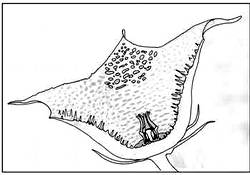
Figure 2 shows the gynostegium of Huernia boleana. The reproductive organs lie between the lobes of the staminal corona. At its lower end the guide rail has a wide, funnel-shaped opening that facilitates insertion of the pollinia. The stigma is concealed on the inner side at the upper end of this rail. The pollinaria are also located there: the pollinia are often protected by membranes, and pairs of pollinia are connected by the translator, which is attached to the gynostegium at the upper end of the guide rail.
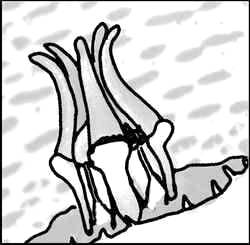
Figure 3 shows a pollinarium glued to the tip of an insect pin for use in pollination.
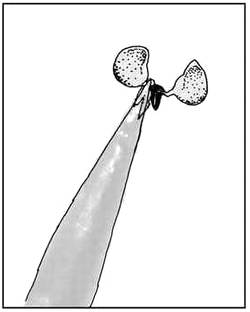
Figure 4 illustrates the flower and bud of Larryleachia cactiformis. The strongly contrasting corolla is tuberculate and depressed in the centre like a shallow soup bowl. The gynostegium has conspicuous horned lobes of the interstaminal corona. The lobes of the staminal corona touch or slightly overlap at the stigma head but do not rise above it.
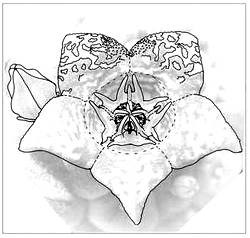
Figure 5 is strongly enlarged and shows an inserted pollinium in Larryleachia picta. The oblique angle that must also be maintained during insertion is clearly visible. The lower and left pollinaria have been removed.
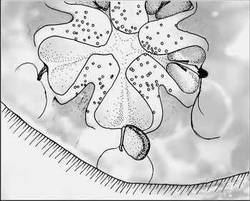
Figure 6, in comparison with Figure 4, shows the floral structure of Larryleachia marlothii. The horns of the interstaminal-corona lobes are curved but, instead of a central horn, bear only slight protuberances. Pollinaria and guide rail are likewise easily accessible. In L. marlothii the staminal-corona lobes are long, rise above the stigma head and touch at their tips. The corolla is also bowl-shaped, with the depression extending about halfway into the corolla lobes. Its surface is rough and granular, like sandpaper.