Ulrich Tränkle & Friederike Hübner
1. Original description
Hoodia juttae Dinter, Neue Pfl. Südw.-Afr.: 34. 1914 and Sukkulentenforschung 2: 91 (1928)
2. Description
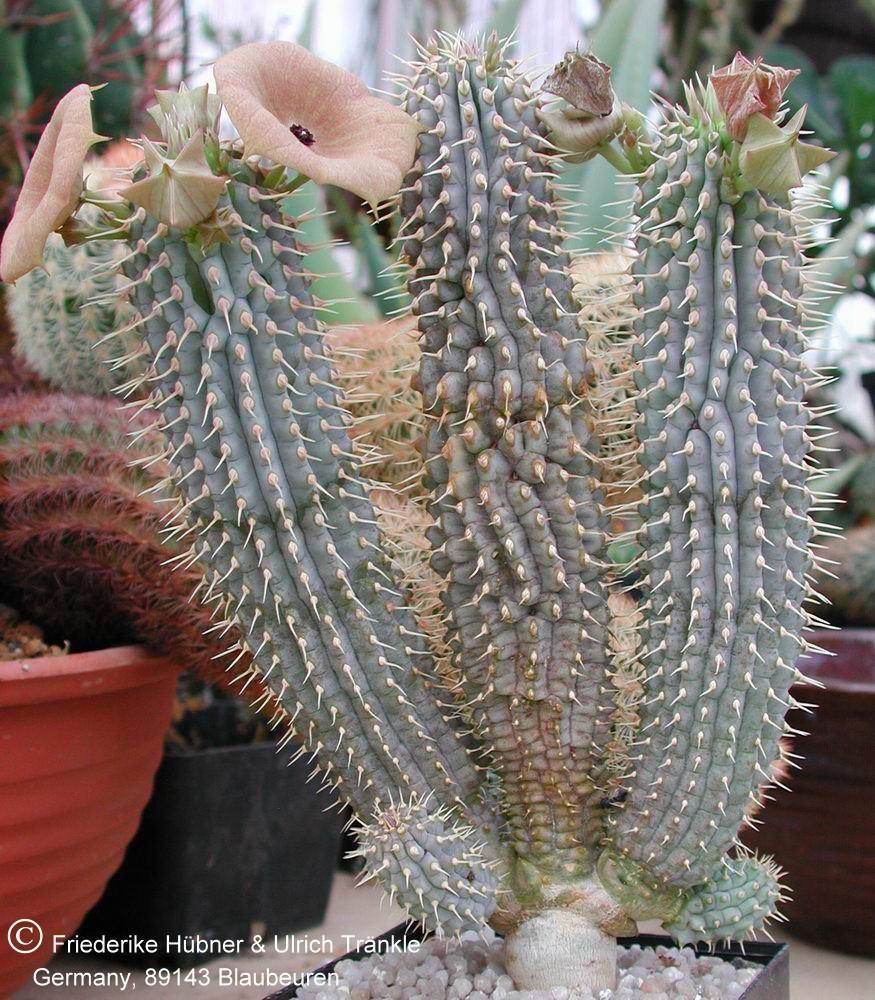
Body: richly branched shrub up to 30 × 50 cm, usually branching from the base; stems pale grey-green, upright, 3–5 cm thick. Ribs: tubercles arranged in 15–17 ribs, each ending in a pale grey-green spine 8–11 mm long. Flowers: in groups of 1–4, opening successively in the upper part of the stem. Pedicel: 10–30 mm long and 2.5–4 mm thick. Sepals: 3–5 mm long, base about ±2 mm wide, glabrous and pointed.
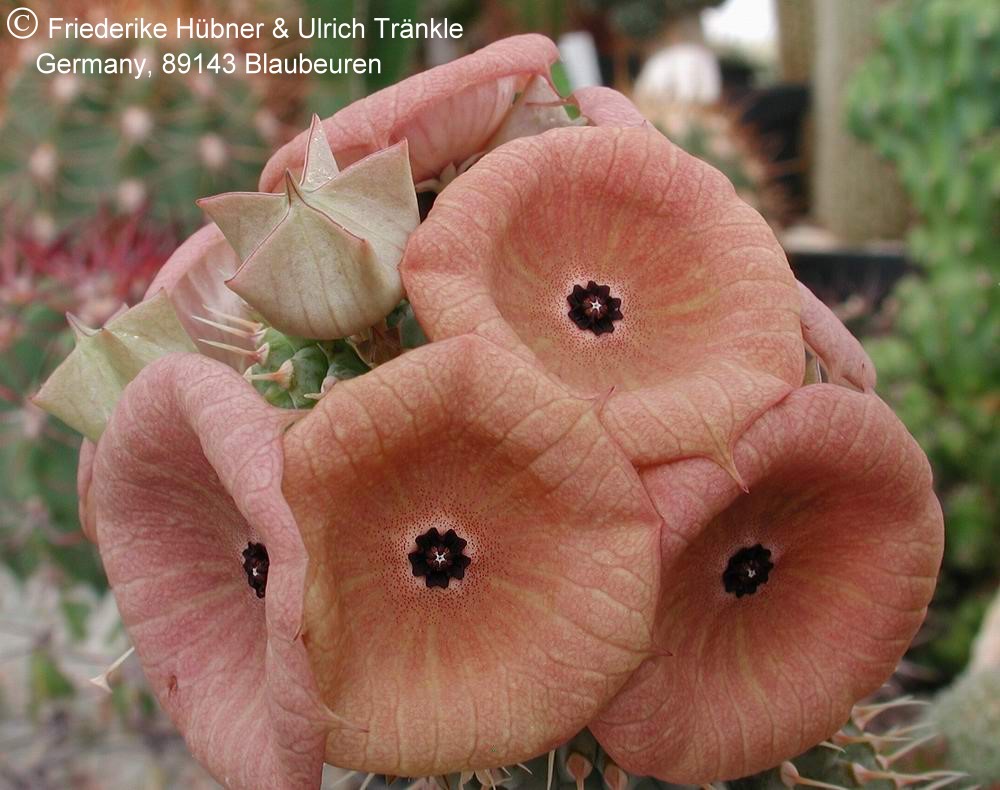
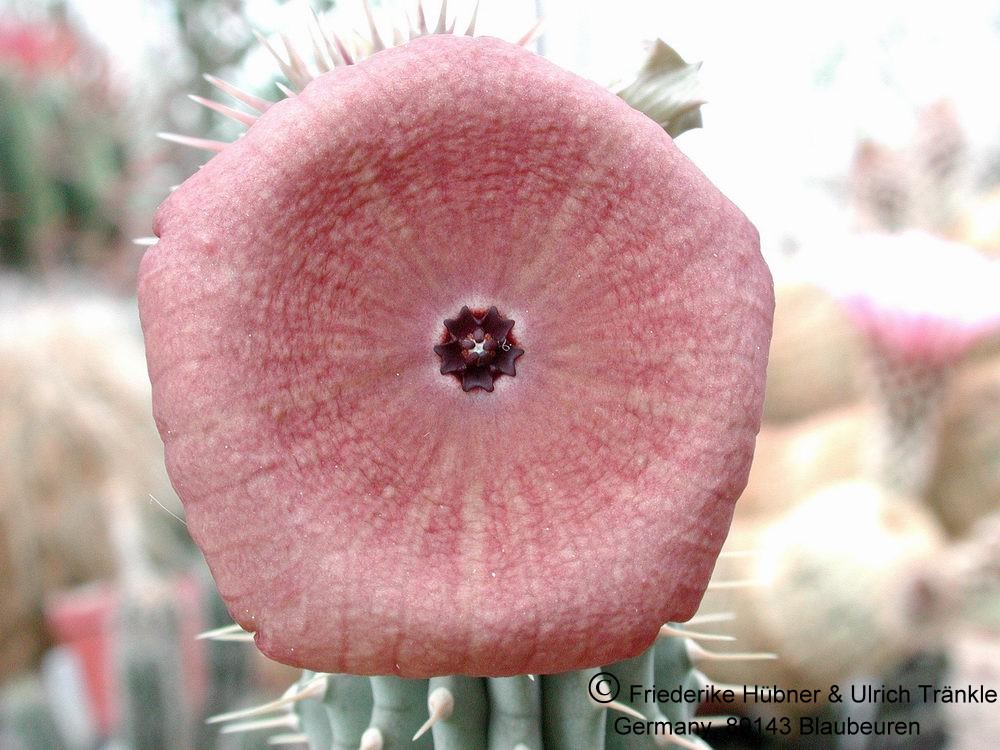
Corolla: 2–5.5 cm in diameter, glabrous and smooth on both surfaces, flat to slightly cup-shaped, broadly five-lobed, with a 1 mm deep cup-shaped tube thickened on the outside. The corolla is pressed against the corona lobes outside the tube. Corolla lobes broadly oval, pointed, 4–8 mm long and 15–25 mm wide at the base. Colour pale yellow-brown outside; inside pale yellow-brown to flesh-coloured with dark veins.
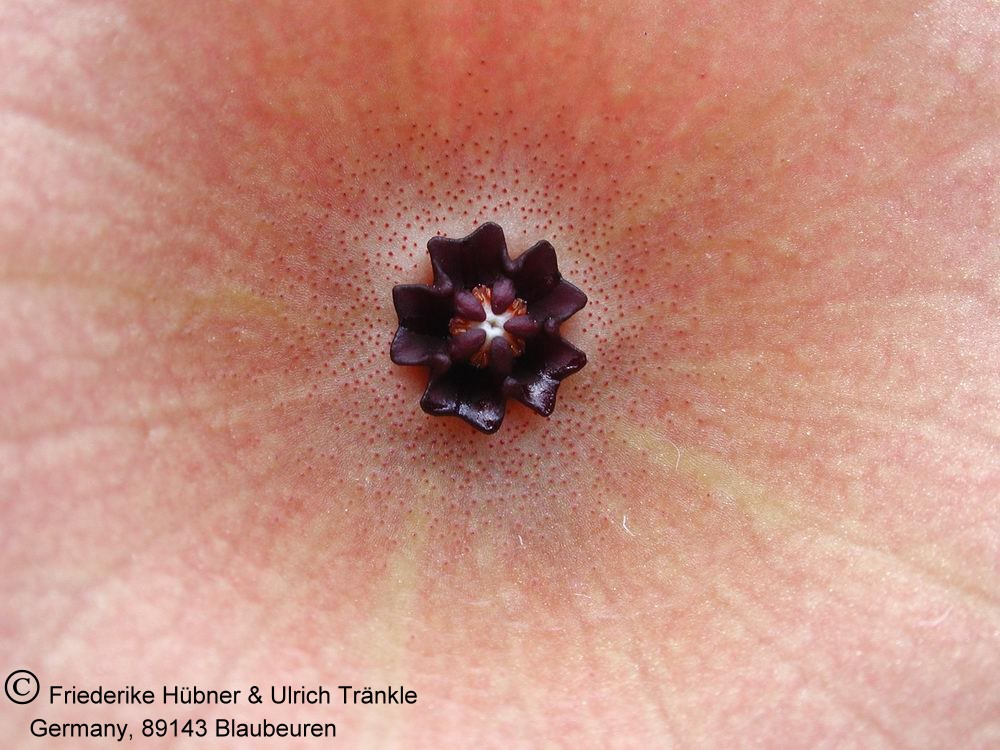
Corona: dark blackish purple. Outer corona (interstaminal corona) cup-like at the base, obliquely truncate outwardly to shortly two-toothed, about ±1.5 mm wide at the base and up to 1 mm long; margin pressed against the corolla. Inner corona (staminal corona) broadly oblong, blunt, lying on the anthers and slightly exceeding them, usually overlapping laterally in the centre. Fruit: follicle, usually two, 140 mm long, with about 270 seeds per pair.
Description after Bruyns, P. V. (1993): A revision of Hoodia and Lavrania (Asclepiadaceae - Stapeliae). Bot. Jahrb. Syst. 115(2): 145–270.
3. Distribution
Restricted to slopes and interior areas of the Little and Great Karas Mountains in southern Namibia.
4. Cultivation
Hoodia juttae prefers a purely mineral, loose and well-drained substrate, apparently especially acidic mixtures. Stagnant heat and full sun at high temperatures rapidly cause shoot tips to dry out and scorch. Waterlogging and high humidity, particularly at temperatures below 10–15 °C, should be avoided, although the species is not exceptionally susceptible to fungal infection.
Re-rooting requires patience and care and is best carried out in pure quartz sand or Seramis in partial shade with cautious but consistent watering. The risk of further rot is high. Overwintering at about ±10 °C is possible; somewhat higher temperatures, for example on a suspended shelf, are also suitable. Grafting onto Ceropegia woodii has proved very successful and produces freely flowering plants. Propagation is best from seed or by grafting offsets.
5. Notes
Without being especially demanding, H. juttae can become somewhat larger over the years because of its branching and relatively rapid growth. It is a prolific and persistent flowerer; plants can be covered in flowers particularly after the winter rest period. Flowering begins at about three to four years of age. True-to-species seed is still not often available. Although the species has become somewhat more common in collections in recent years, it remains very rare. With some practice, hand pollination is straightforward. Spontaneous fruit set is not known. Natural hybrids have not been documented, although very attractive hybrids occur in cultivation.