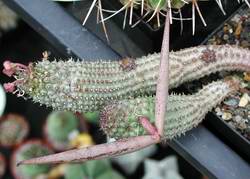
Ulrich Tränkle & Friederike Hübner
1. Original description
Trichocaulom pedicellatum Schinz (1888), Verh. Bot. Vereins Prov. Brandenburg 30: 266
2. Description
Body: up to 20 or more stems, branching from the base; young stems ± upright, later ± upright to creeping, 100–250 (–500) mm long and 25–50 mm thick. Ribs: tubercles arranged in 11–20 ribs, each ending in a dark spine 1.5–3 mm long.
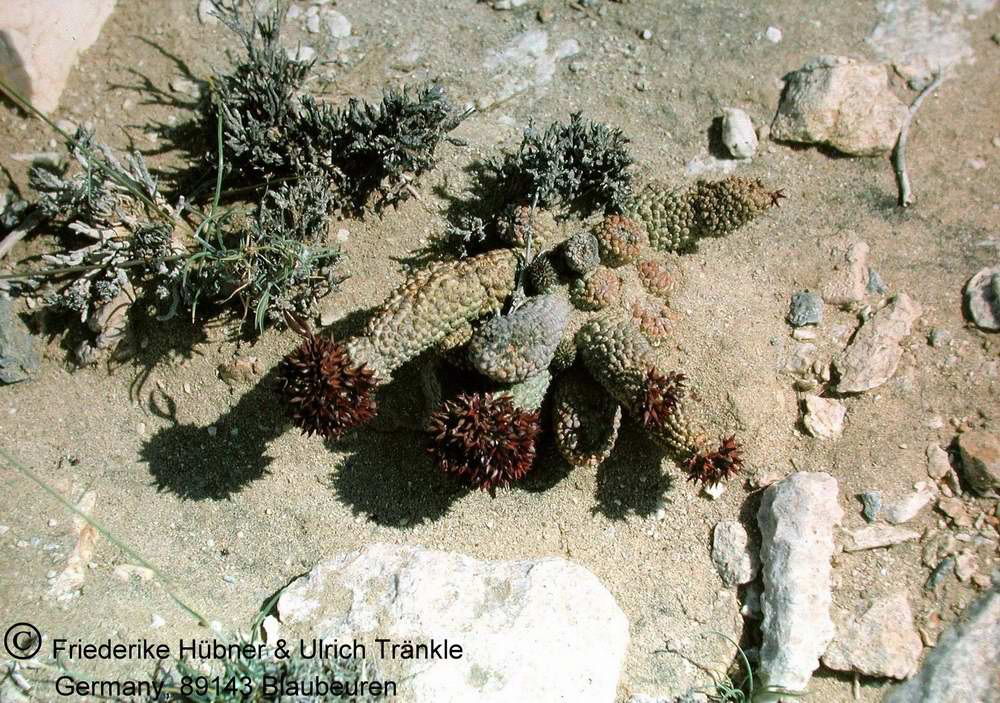
Flowers: in groups of 1–4, mainly in the upper part of the stem and developing successively. Pedicel: 4–12 mm long, smooth and curved downward. Sepals: 1.5–2 mm long, smooth, lanceolate and pointed.
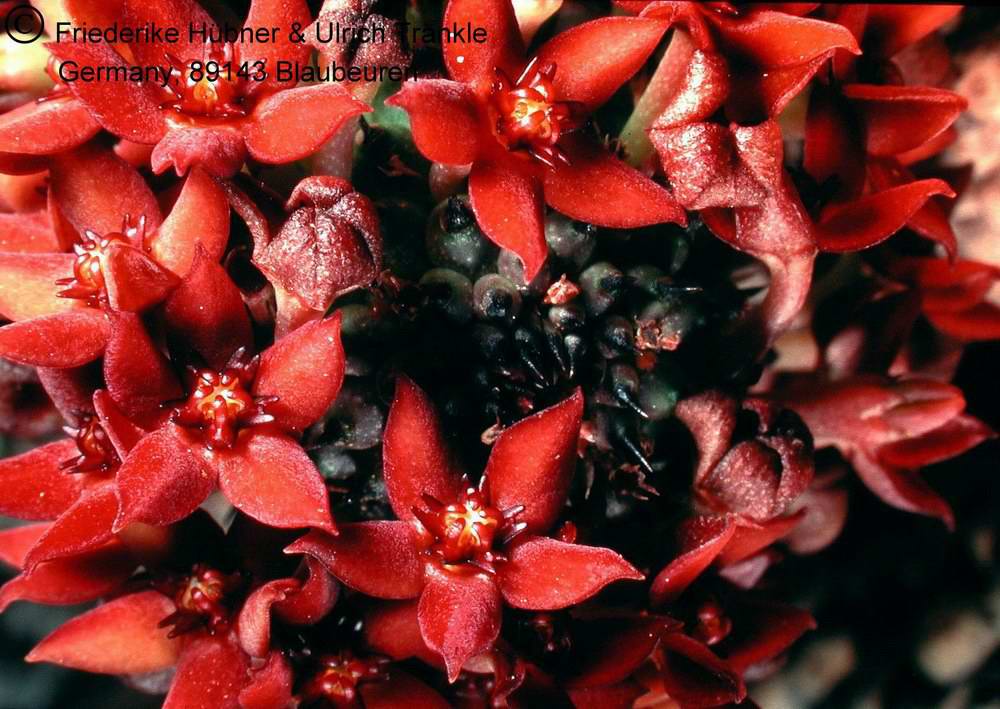
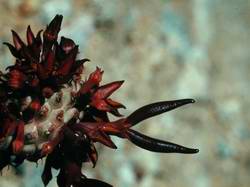
Corolla: 8–14 mm in diameter, nodding, finely papillose, with the centre smooth like the outer surface. Colour chestnut-brown or light to dark purplish brown, with slight swellings where the corolla lobes meet. Tube <1 mm, enclosing the base of the corona. Corolla lobes upright to spreading, 3–6 mm long and 2.5 mm wide at the base, lanceolate, pointed, margins turned downward. Corona: purplish brown or yellow, smooth, 3–3.5 mm in diameter. The outer corona (interstaminal corona) extends horizontally from the gynostegium and is divided halfway or deeper into two short, spreading teeth; laterally it is fused with the dorsal side of the inner corona. The inner corona rises from the level of the outer corona and curves inward, often meeting in the centre; it is blunt and very variable in length. Fruit: mature follicles of a pair spread at an angle of 170–180°; one follicle about 7 cm long with 25–30 seeds.
Description after Bruyns, P. V. (1993): A revision of Hoodia and Lavrania (Asclepiadaceae - Stapeliae). Bot. Jahrb. Syst. 115(2): 145–270, supplemented with fruit characters.
3. Distribution
Confined to the coastal fog zone of the Namib Desert, from south of Swakopmund in Namibia to just north of Foz do Cunene in south-western Angola. The range is probably restricted to a coastal strip about 80 km wide.
4. Cultivation
Hoodia pedicellata prefers purely mineral, loose and well-drained substrates. Acidic substrates, for example those containing granite, appear to be preferred, although the root system differs little between alkaline and acidic mixtures. Stagnant heat and full sun at high temperatures should be avoided, because H. pedicellata, like all Hoodia species, tends to suffer drying and scorching of the shoot tips. Waterlogging and high humidity, especially at temperatures below 10–15 °C, should also be avoided, although the species is not particularly susceptible to fungal disease.
Re-rooting requires considerable patience and care and is best undertaken in pure quartz sand in partial shade, with cautious but consistent watering. The risk of further rot is high. Overwintering at about ±10 °C is possible; higher temperatures, for example on a suspended shelf, are also suitable. Grafting onto Ceropegia woodii has proved very successful and produces freely flowering, strongly branching plants. Propagation is best from seed, although seed is very difficult to obtain.
5. Notes
H. pedicellata is very rare in collections because seed and plant material are scarcely offered. Hand pollination succeeds only for experienced growers: in addition to the complex pollination mechanism typical of Asclepiadaceae, the pollinia are oily and therefore slippery. Spontaneous fruit set occurs only very rarely, but when it does the species is apparently self-fertile. Hybrids are not known. In summer H. pedicellata is an exceptionally prolific and constant flowerer, and the unpleasant odour characteristic of many asclepiads remains relatively mild.
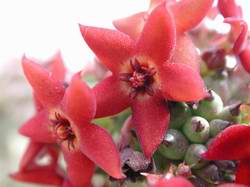
Following the revision of Hoodia and Lavrania by Bruyns (1993), H. pedicellata was transferred from Trichocaulon to Hoodia sect. Trichocaulon.